![]() |
| The Summoner - The Canterbury Tales |
Thursday, November 19, 2020
Ye Olde Queers: The Role of Homosexuality in the Middle Ages
Wednesday, November 18, 2020
A Clash of Two Communities: "The Man of Law's Tale"
I find that each story in Chaucer’s Canterbury Tales can be recognized for a specific theme or message that the work is trying to portray. What really caught my eye was “The Man of Law’s Tale” and its representation of a collision of two very seperate worlds. It demonstrates what occurs when people from very different communities get entangled, and when faced with religious conversion.
This work is about a super virtuous Catholic woman named
Custance. She is married off into a community of pagans, and undergoes just
about every hardship possible at the hands of two very sinister mothers-in-law.
Despite every adversity that she endures, she is basically saved by her faith,
which remains stronger than ever: “Chaucer authenticates a miracle by asking
why Custance was not slain with other Cristians at the massacre plotted by the
Sultan’s mother (470-71). God saved Custance” (Johnson 5) In the process, she is
able to convert an entire community of people without even trying.
The way in which religious conversion is depicted in the
tale is quite interesting. Chaucer paints Christianity as a religion so powerful
that when one meets a believer who performs a miracle, others will willingly make
the choice to convert. Unlike the original story that the work is based off of,
Lewis states that “Chaucer omits Custance’s role as actively preaching to the
merchants and causing them to be baptized, a move that would seem to result in
a passive rather than an active missionary bride” (14). He focuses the reader’s
attention on Custance as the bearer of faith. Interestingly enough, while doing
this, Chaucer also portrays her as a paragon of faith and purity. She
represents the perfect image of the Catholic Church.
Despite this misrepresentation of Islam that the author depicts, he also seems to hint that the two religions are more alike than different. This is something that both communities in real life may ignore, viewing each other as the enemy. Khan writes that “what is ignored is that the Christians’ belief in the fundamentals and traditions of Christianity is much more similar to the Muslims thinking on their own beliefs” (12). They really are not much different after all, but many refuse to look at the commonalities.
In the original story by Trivet, two main priorities of the Crusades are depicted. These are territorial expansion and the possession of Jerusalem. Interestingly enough, in Chaucer’s version of the tale the main goal is spiritual conversion of the Syrians by the Romans. Islam and Christianity clash in this story, showing its readers the huge impact that this has on both communities. Custance becomes the posterchild for her religion and all things good, while various Muslim characters are written in a completely different manner.
Monday, November 16, 2020
Gender Role Reversal in the Miller's Tale
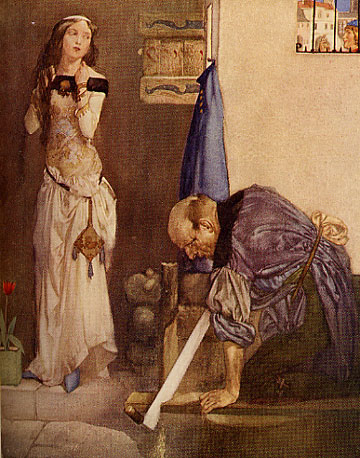
Painting of Alisoun standing over John the Carpenter
Gender Role Reversal in The Miller's Tale
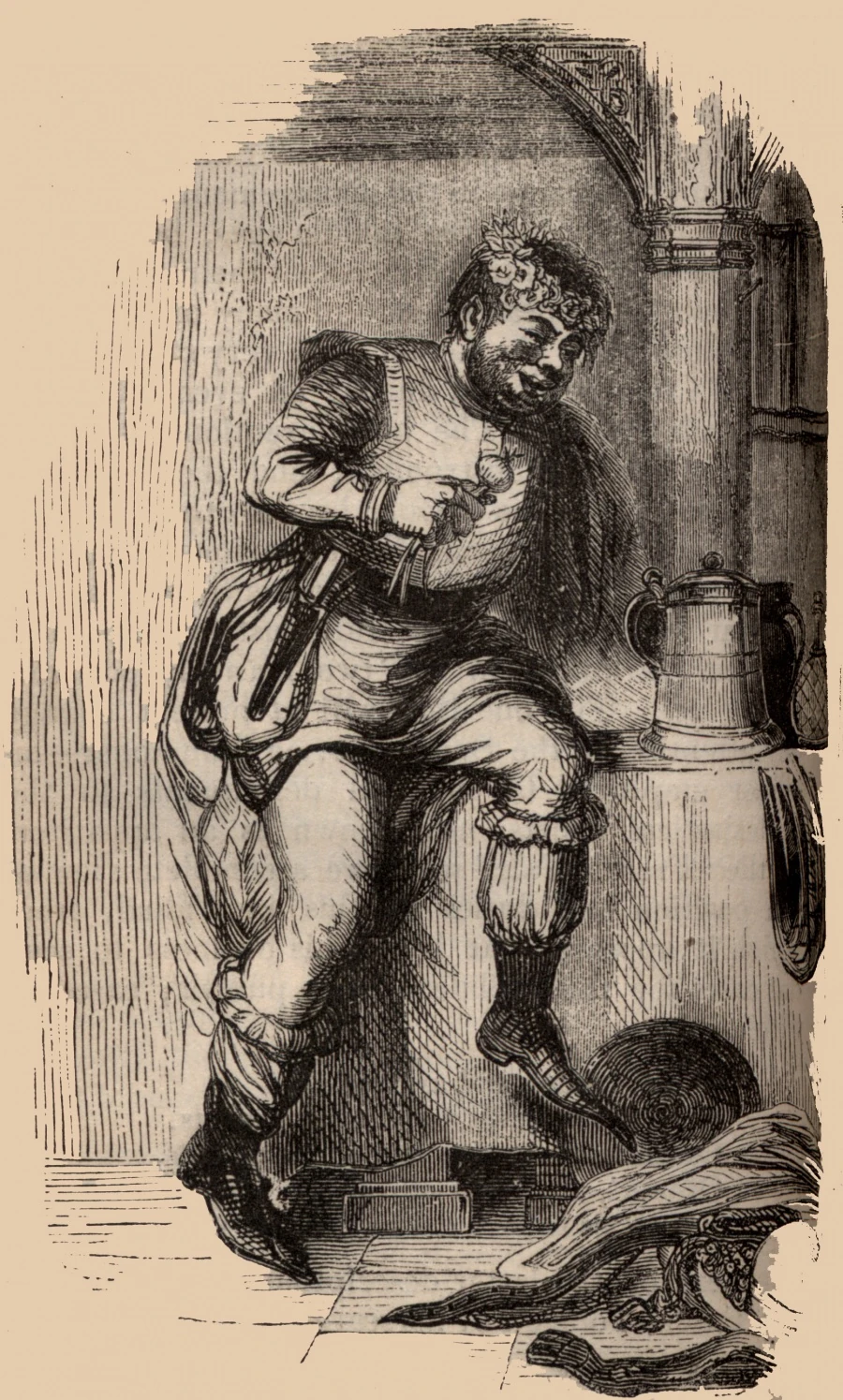
Furthermore, the gender roles seem to be reversed here since the Male characters are seemingly the ones who are punished for adultery. In the Middle Ages, it was way more common that the woman would more so suffer the consequences of adultery. This is because a man at this time should have proper control over his wife. The male characters are Abolon, Nicholas, and John. In the end, despite being cheated on by John the Carpenter is actually seen as a laughing stock of the town. Absolon punished Nicholas, by sticking a hot stick up his rear, in reaction to Alisoun punishing Absolon tricking him into kissing her rear. The dark humor and love triangle action actually make these characters lose their masculinity in the end. Shannon Forbes writes about Absolon’s lack of masculinity. This is seen when Forbes writes, “Perhaps most seriously, however, Absolon fails to consistently enact the role of the courtly lover because he cannot successfully execute his male authority over the female object of his love” (Forbes 5). Here Forbes suggests that Alisouns’s power seems to stop Absolon from forcing Alisoun to love him.
To sum it up, by using these sources, this project will further prove that the gender roles are reversed in Chaucer’s Miller’s Tale. This is due to the main points that Alisoun exhibits power that women did not typically have in the Middle ages. The power Alisoun has with her choices and rejections causes the male characters to lose their masculinity. This is seen through their inability to love her and their punishments for adultery. Therefore, the gender roles of the female and male characters are swapped in Chaucer's Miller’s Tale.
Sunday, November 15, 2020
Gender Dynamic in "The Wife of Bath's Tale"
Friday, June 5, 2020
Rape and Justice in the Middle Ages
Wednesday, June 3, 2020
Rape Culture in the Middle Ages
![]() |
| The young, beautiful wife. https://study.com/academy/lesson/the-wife-of-baths-tale-in-the-canterbury-tales-theme-analysis.html |
Homophobic Behavior in the Middle Ages
![]() |
| http://www.luminarium.org /medlit/pardonport.htm |
![]() |
| https://uncrcow.tumblr.com /post/179114171134/ how-was-homosexuality- treated-in-medieval-times |
Tuesday, December 11, 2018
Religion in Geoffrey Chaucer's "The Prioress' Tale"
This semester we read several literary works that connect to Gender, Religion, and Disability.
In Geoffrey Chaucer's The Canterbury Tales, religion is a prominent theme, especially in "The Prioress' Tale."
In "The Prioress' Tale," there are traces of anti-Semitism by the way that Jews are treated in the tale. The Prioress specifically is classified as having a negative attitude towards Jewish people. She is labeled as being anti-Semitic by the way that she talks about the Jews. Critics such as Denise Despres say that, "the Prioress' virulent brand of anti-Judaism." She is labeled as being anti-Semitic because of the way that she tells her tale.
The Prioress in Geoffrey Chaucer's "The Prioress' Tale."
|
"The Prioress' Tale," serves as evidence of the existence of anti-Semitic ideas for a long time in history. The tale is compared to events in history such as the Holocaust during World War II. Critics such as Greg Wilsbacher claim that, "'The Prioress' Tale' is ruined by the similarity between...some of the anti-Semitic propaganda whiich was current in Nazi Germany, and which is still in operation, not only in numerous foreign countries but also here at home." He compares "The Prioress' Tale" to the propaganda that was used during World War II. The propaganda that was used contained anti-Semitic ideas just like in Chaucer's "The Prioress' Tale." This shows that the idea of anti-Semitism has existed throughout history. During the time of the Holocaust, Jews were treated similarly to how they are treated in the tale. In both situations, Jews were persecuted and killed for their religion.
The Disabling Qualities of The Prioress in Chaucer's The Canterbury Tales
This semester my Middle English Literature class explored several texts looking specifically at gender, disability, and religion in the texts and identifying the links between them. While I had read some of the texts in the past, this new perspective allowed for a fresh read and new insight into these works. One of the texts, Chaucer's The Canterbury Tales, explores the intentions of several religious figures through the implications of the tales they tell on their pilgrimage.
My term paper for this class looked closely at the Prioress' introduction in the General Prologue and the implications of her tale. Through my discussion I examined the possibility that the Prioress is not a good Christian woman and that she disables those around her with her inability to look past her own self. This is implied as early as the General Prologue with the physical descriptions of the Prioress. Thomas Farrell discusses this in his article “The Prioress’s Fair Forehead” in which he seeks to understand Chaucer’s attention to the Prioress’ physical description, specifically her forehead: “But sikerly she hadde a fair foreheed-/It was almost a spanne brood, I trowe” (Chaucer ll.154-155). Farrell tries to determine what a “spanne” is in Chaucer’s time and explain how this is a way of implying the Prioress’ size (Farrell 212). This would show that she indulges in large amounts of food and beverage which is not typical of someone involved in the clergy who should be giving more to others and taking less for themselves. This is evidence of her selfishness which takes away from others and therefore has a disabling quality.
Another oddity in the tale is the way the Prioress uses apostrophe in order to cover up her inappropriate comments regarding the Jews. Jessica Fenn identifies this tactic in her article “Apostrophe, Devotion, and Anti-Semitism: Rhetorical Community in the Prioress’s Prologue and Tale” where she cites examples of the Prioress’ language. One example of this is her call to God followed by the reference to the Hugh of Lincoln (Chaucer ll. 683-684). She calls to God to gain authority over what she is going to say and then references a well-known story to bring credibility to her own tale (Fenn 435). However, introducing the Hugh of Lincoln adds to the idea that she is trying to present the Jews in a negative light and her anti-Semitic beliefs. Geraldine Heng provides helpful information about the Hugh of Lincoln in her article “England's Dead Boys: Telling Tales of Christian-Jewish Relations Before and After the First European Expulsion of the Jews.” Heng’s article brings to light the fact that the Prioress’ tale includes a much more extreme punishment of the Jews than in the original story that her tale parallels. This is evidence of her blinding hatred which disables the Jews in her eyes. The Prioress’ selfishness coupled with her inability to see beyond her own point of view disables not only those around her, but also herself as she is unable to fulfill her Christian duties.
![]() |
| Image of the Prioress |
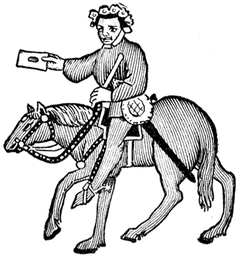
The Summoner: The Man Sick with Sin
Within the “General Prologue” of The Canterbury Tales, Chaucer describes the character known as The Summoner to be infected with a terrible disease. He is described to be covered in cysts, lumps, infections, and pimples. His face is horribly inflamed, red, and so swollen that he can barely keep his eyes open. His appearance is so terrible that it frightens children. Many scholars have speculated on what exactly ails the man. Some say it is dry scabies, late-stage syphilis, or gutta rosacea. No matter his exact diagnoses, during Medieval England, he most likely would have been said to have leprosy, as this term was unknowingly used to diagnose an incredible amount of diseases due to the limited understanding of illnesses.
![]() |
| Visual representation of The Summoner |
Sharon Rhodes offers her opinion regarding The Summoner’s disease and sins. She considers leprosy to be an obvious mark on a person that advertises their sins to the world. She explains, “Consequently, . . . Chaucer’s Summoner . . . appear[s] as [a] leper[ ]. The[ ] character[‘s] skin[ ] publicly broadcast[s] their private wickedness, allowing—even forcing—the audience to visualize the effects of sin which would otherwise be unreadable.” Generally, once a person sinned enough for it to be reflected on their skin in the form of a disease, they would make some positive changes in their life in an effort to rid themselves of the illness. However, The Summoner chooses not to make changes to his lifestyle and continues to sin as much as he had before becoming a leper. Rhodes speculates that his pilgrimage to Canterbury is a last-ditch effort to save himself. It was said that in Canterbury, those with leprosy could receive a type of holy water made with a small amount of St. Thomas’ blood, which was believed to cure the disease from those who truly seek forgiveness from God.
Sunday, October 25, 2015
Understanding Masculinity: Today and in the Medieval Period
Monday, October 12, 2015
The Wife of Bath, Miley Cyrus and Feminism
This prologue, and tale, offers a
plethora of females: the smart, the promiscuous (and gap toothed), the mystical
and obedient. The Wife of Bath is unapologetically woman, and she does not
apologize for her sex, her many husbands or the fact that she “nyl nat enye no
virginitee” (142). Though the females
featured in the prologue are either well-known fictional or historical figures,
the Wife of Bath creates the women presented in her tale. With her development
of these female characters, I cannot help but to think of things such as the
woman question, or Miley
Cyrus and her absurdity (sorry for any Cyrus fans out there). Cyrus, who may seem like an odd choice to
compare the Wife of Bath to, uses her feminist perspective to advocate for
things such as gay rights, sexual freedom and not shaving your armpits (also
known as “lets make everyone European”). The Wife of Bath’s characterization reflects
Cyrus’ advocacy because they are both challenging social norms: the Wife of
Bath’s unapologetic stance on sex, and her lustily disposition, is extremely
forward, and Cyrus’ performance, and display of her body, delivers a similar shock value. In her tale, the Wife of Bath discusses the Knight, who raped a young maiden, and later saved by an "old" woman. The tale highlights female appearance, and how society measures female value: virginity, as mentioned in the prologue, or beauty, as pointed out in the tale. This mimics themes seen in classic Disney movies, specifically Snow White and the purity of her pale, beautiful skin. Commodifying women, and using their beauty and virginity as trade, appears to be an issue that has especial longevity. The transformation of the Wife of Bath's old hag into a beautiful woman is reminiscent of the Evil Queen's metamorphosis in Snow White, and positions the female body as a tool for deceit.